

Gilbert's syndrome is often described as harmless, but many of the people who answered our survey say it still shapes their daily life, and that they struggle to find clear answers about it.
22 people with Gilbert's syndrome, or who are being assessed for it, told us how it affects them, what triggers it, where they look for help and what is still missing.
Based on this research, and on working with friends and family, I built Loops to help people manage and find treatments for overlooked chronic conditions. This post shares what we heard, and how Loops responds to it.
What is Gilbert's syndrome?
Gilbert's syndrome is a common inherited condition that affects how the liver handles bilirubin. Bilirubin is a yellow pigment made when the body breaks down old red blood cells. Normally the liver processes it and clears it from the body in bile (MedlinePlus). In Gilbert's syndrome, a change in the UGT1A1 gene leaves the liver enzyme that does this working at about 30% of its normal level. Bilirubin is cleared more slowly, so it can build up in the blood from time to time (MedlinePlus).
It's estimated to affect 3 to 7% of people in the US, and some estimates run as high as 16% (StatPearls). It's more common in men and is usually noticed in the teenage years. About 30% of people with it have no symptoms and only find out through a routine blood test (MedlinePlus).
When bilirubin rises, it can cause mild yellowing of the skin or eyes. Episodes are often brought on by fasting, illness, dehydration, stress, intense exercise or menstruation, and some people have tiredness or abdominal discomfort. Doctors generally consider it harmless and it needs no treatment (StatPearls). That's exactly why many people living with it feel their experiences get overlooked.
What do the numbers look like? A normal total bilirubin level in adults is 0.1 to 1.2 mg/dL (about 2 to 21 μmol/L), though ranges vary slightly between labs (MedlinePlus). In Gilbert's syndrome, total bilirubin is usually only mildly raised, typically staying below 4 mg/dL (about 68 μmol/L), and other liver tests are usually normal (StatPearls). Levels go up and down, and often rise during the triggers above.
Who took part
Most respondents have lived with a diagnosis for years: 13 of the 22 were diagnosed more than three years ago.
- Sex: 17 men and 5 women.
- Diagnosis: 19 have been diagnosed by a healthcare professional. 3 are still being assessed.
- How it was found: routine blood tests for 10 people, checks on yellowing eyes or skin for 6, and tests for another health concern for 6.
For almost half, Gilbert's syndrome was found by chance, not because they went looking for it.
How much it affects daily life
For 41% of respondents, Gilbert's syndrome is far from harmless. When asked to rate on a scale of 0 to 10 how much it had disrupted their daily life in the past four weeks, 9 of 22 people chose 7 or higher. Their average was 8.4. Another 5 people said it hadn't disrupted their life at all.
41% of people say Gilbert's syndrome seriously disrupts their daily life
9 of 22 people scored 7 or higher (highlighted) · 5 scored 0
Seriously affected: 41% (9 people), average score 8.4
- 5 people scored 0
- 1 person scored 1
- 1 person scored 2
- 1 person scored 3
- 2 people scored 4
- 2 people scored 5
- 1 person scored 6
- 2 people scored 7
- 3 people scored 8
- 2 people scored 9
- 2 people scored 10
Disruption in the past four weeks (0 = not at all, 10 = a great deal) · number of people
What life looks like for the 41%
The people most affected aren't short of effort. They have tried more than anyone, and they're still left without answers.
- They've already changed how they live. 7 of the 9 have changed their daily habits, compared with 2 of the other 13.
- They notice more triggers. On average they link flare-ups to 4 different situations, against fewer than 3 for everyone else. Illness and dehydration affect 7 of the 9.
- Seeing a doctor hasn't settled it. 6 of the 9 have spoken with a healthcare professional, yet every one of the 9 still has questions they can't get answered. 7 are still unsure about medication.
- It affects their relationships too. 7 of the 9 list explaining the condition to others among their biggest concerns, compared with 2 of the other 13.
“Living with Gilbert's syndrome has not been easy, at least for me. I have not found anything which would make living with it easier.”
These people need answers, not reassurance. What they asked for most was questions to take to their doctor and stories from people like them (6 of the 9 for each).
The other 59% aren't untouched either. 8 of these 13 people still reported some disruption, with scores between 1 and 6. 9 have noticed at least one trigger, and 9 still have questions they can't get clear answers to. Most often, they want to know whether their other symptoms are related (8 of 13). Lower disruption today doesn't mean Gilbert's syndrome has no effect.
Triggers people notice
Most people have spotted a pattern. 18 of 22 linked yellowing of the eyes or skin, or higher bilirubin results, to at least one situation.
Dehydration, illness, fasting and stress are the most common triggers
People who noticed yellowing or higher bilirubin in each situation, out of 22 (more than one answer allowed)
- Dehydration12
- Illness or infection11
- Fasting or skipping meals10
- Stress10
- Poor sleep8
- Alcohol8
- Strenuous exercise5
- Menstruation2
People also mentioned very rich meals and certain foods. The other 4 were unsure, hadn't noticed a pattern, or hadn't had these changes.
What people worry about, and what they can't find answers to
Day-to-day choices matter most. 15 of 22 people listed food, fasting or lifestyle among their top concerns in the past four weeks.
The other concerns people raised most often:
- whether their other symptoms are related to Gilbert's (11 people)
- explaining the condition to others (9)
- yellowing of the eyes or skin (8)
When we asked which questions they still can't get clear answers to, the same themes came back:
- whether lifestyle changes are actually needed (12 people)
- medication considerations (11)
- whether a symptom needs to be investigated separately (8)
- inheritance and family questions (5)
Only 3 people said they had no open questions.
In their own words
We asked people to describe the last time they had a question or concern about Gilbert's syndrome. Four themes came up again and again. Quotes are anonymous and lightly edited for spelling.
Feeling brushed off. Several people said that being told the condition is benign didn't match what they were living with.
“To just be told it's harmless and not to worry. Completely ignoring how much it can affect mental health and social life being jaundiced.”
“If doctors understood that the symptoms are real and don't shrug it off as a benign condition.”
“My doctor just told me it's a benign disease and I have nothing to worry about... he didn't even tell me what I can do to minimize negative effects from it, which I had to research myself.”
Symptoms nobody can explain. Fatigue, brain fog, poor sleep and abdominal pain came up often. People wanted to know whether these are connected to Gilbert's or need to be checked separately.
“In all the cases they say it is harmless, but where do my symptoms come from?”
“No healthcare professional has been able to tell me if this pain is directly related to Gilbert's syndrome, because of that I have been trying to do my own research.”
Food, fasting and alcohol. Many described learning their own triggers through trial and error.
“I asked AI if my overnight fast was too long because I was consistently waking feeling nauseous and dreadful. It was!”
“It makes me feel awful even after a small amount [of alcohol]. It was not always this way.”
For some, it's a non-issue. Not everyone is affected, and that matters too.
“Gilbert's for me is a non-issue, just a footnote in my medical records.”
Where people look for help
Online communities are the first stop: 16 of 22 people have used them, more than had spoken to a healthcare professional (12).
Other steps people have taken:
- read medical websites (15)
- changed daily habits (9)
- kept a record of symptoms or blood results (5)
Reddit was the resource named most often, followed by Facebook groups, Google, AI chatbots and the NHS website. People value how supportive these communities are. What they find missing is research, doctors who know about the condition, and clear answers on whether symptoms are related:
“What's missing is research and doctors being aware of it.”
How Loops answers what people asked for
People want information they can trust first. 15 of 22 asked for clear explanations with sources, well ahead of any other feature. That's where Loops starts.
Clear, sourced explanations are the most wanted feature
People who chose each feature for a new website, out of 22
- Clear, sourced explanations15
- Patient stories10
- Questions to ask a clinician9
- A record of results and concerns9
- Moderated discussions6
- Help understanding bilirubin results5
- Chatbot4
Loops brings together what people told us they're missing:
- Clear, sourced information alongside real patient stories. Plain-language summaries of trusted medical sources, such as the NHS, Mayo Clinic and Cleveland Clinic, sit next to the experiences of people living with the condition.
- Treatment options narrowed down to your profile. Instead of a generic list, Loops matches you with people of the same sex, age group and symptoms, and shows what they've tried and how well it worked for them. We haven't found anything else that does this.
- Questions to take to your doctor. Loops helps you prepare questions for each appointment, so you walk in ready and leave able to act.
- A weekly tracker. Log symptoms, sleep, stress, food and flare-ups to uncover your triggers, spot patterns over time and see whether other symptoms tend to show up alongside your flare-ups. That gives you real evidence to take to your doctor.
People also told us what would put them off using a site like this: cost (9 people), doubts about accuracy (7), the effort involved (6) and privacy concerns (4). That's why every explanation links to its sources, and why Loops remembers your history so you never have to start from scratch.
About these results
This is a small survey that shouldn't be confused with a scientific study. Its 22 respondents chose to take part, mostly through online communities. People who are more affected may be more likely to answer, and most respondents were men. Some questions asked people to pick up to two or three options, but some picked more, so the counts show how often each option was chosen, not a ranking.
This post shares people's experiences, not medical advice. If you have new or unexplained symptoms, speak to a doctor.
What's next
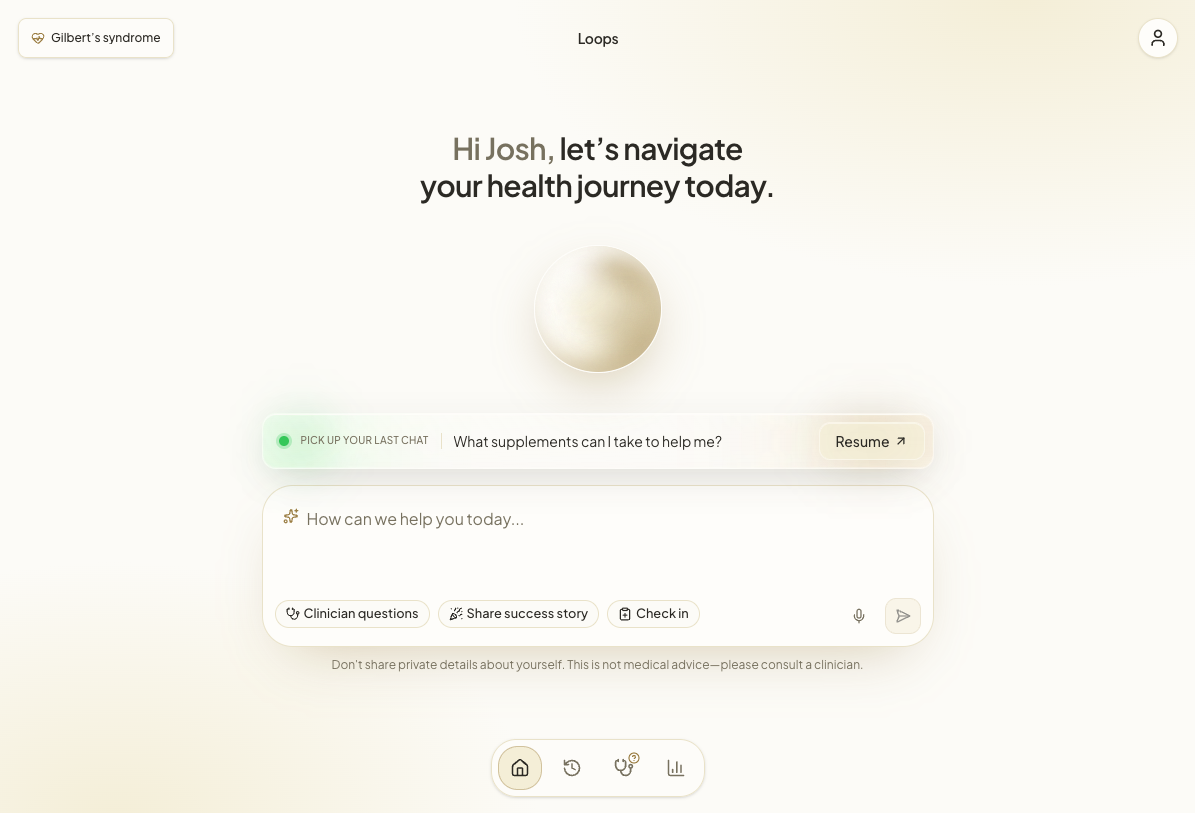
Loops is live, and people are already using it. Everyone who joins adds to what we know, so the insights there can already help you, and they get more useful with every new member.
Gilbert's syndrome was just the start. Loops now covers:
- Chronic obstructive pulmonary disease (COPD)
- Diabetes
- Eczema
- Endometriosis
- Gilbert’s syndrome
- Irritable bowel syndrome (IBS)
- Multiple sclerosis
- Myalgic encephalomyelitis (ME/CFS)
- Sleep apnea
Thank you to everyone who took part in the survey.
If you live with Gilbert's syndrome or any of these conditions, join Loops and help shape what comes next.
Appendix: full survey results
Here are the survey's multiple-choice questions about living with Gilbert's syndrome, exactly as they were asked, with all the answers. Percentages are out of all 22 respondents. Where people could pick more than one answer, the percentages add up to more than 100%. Some people picked more options than a question allowed, and we've counted every answer they gave. Open-text answers aren't shown, to protect people's privacy.
1. Are you a:
- Male17 (77%)
- Female5 (23%)
2. Has a healthcare professional diagnosed you with Gilbert’s syndrome?
- Yes19 (86%)
- Currently being assessed3 (14%)
3. How long ago were you diagnosed?
- Under 6 months3 (14%)
- 6–12 months1 (5%)
- 1–3 years4 (18%)
- More than 3 years13 (59%)
- Not diagnosed1 (5%)
4. During the past four weeks, how much have concerns or experiences you associate with Gilbert’s syndrome disrupted your daily life? (0 = not at all, 10 = a great deal)
- 05 (23%)
- 11 (5%)
- 21 (5%)
- 31 (5%)
- 42 (9%)
- 52 (9%)
- 61 (5%)
- 72 (9%)
- 83 (14%)
- 92 (9%)
- 102 (9%)
5. How was Gilbert’s syndrome first identified or suspected?
- Routine blood tests10 (45%)
- Investigation of yellowing eyes or skin6 (27%)
- Investigation of another concern6 (27%)
6. Which concerns have mattered most to you during the past four weeks? Select up to three.
- Food, fasting, or lifestyle questions15 (68%)
- Whether other symptoms are related11 (50%)
- Explaining the condition to others9 (41%)
- Yellowing eyes or skin8 (36%)
- Medication questions3 (14%)
- Understanding bilirubin results1 (5%)
- None2 (9%)
- Other1 (5%)
7. Have you noticed yellowing of your eyes or skin, or higher bilirubin results, around any of these situations? Select all that apply.
- Dehydration12 (55%)
- Illness or infection11 (50%)
- Fasting or skipping meals10 (45%)
- During stress10 (45%)
- After poor sleep8 (36%)
- Alcohol consumption8 (36%)
- Strenuous exercise5 (23%)
- Menstruation2 (9%)
- I haven’t noticed a pattern2 (9%)
- I haven’t experienced these changes1 (5%)
- Unsure2 (9%)
- Other2 (9%)
8. What have you done to understand or manage concerns about the condition?
- Used online communities16 (73%)
- Read medical websites15 (68%)
- Spoken with a healthcare professional12 (55%)
- Changed daily habits9 (41%)
- Recorded symptoms or blood results5 (23%)
- Other4 (18%)
9. Which questions do you still struggle to find clear answers to? Select up to three.
- Whether lifestyle changes are necessary12 (55%)
- Medication considerations11 (50%)
- Whether a symptom needs separate investigation8 (36%)
- Inheritance and family questions5 (23%)
- Whether follow-up is needed4 (18%)
- What Gilbert’s syndrome means2 (9%)
- Understanding test results1 (5%)
- None3 (14%)
- Other2 (9%)
- No answer1 (5%)
Loops Gilbert's syndrome survey · 22 responses, 14–28 October 2026